
Population growth is reshaping rental markets across the South and West, where fast-growing cities and nearby counties are absorbing many of the country’s newest movers. The U.S. Census Bureau reported that cities across all regions grew from 2023 to 2024, with Southern and Western cities seeing accelerated growth; Princeton, Texas, topped the list of fastest-growing cities with a 30.6% growth rate, while Houston had one of the largest numeric gains.
That growth is not just happening inside city limits. Census data also shows that since 2021, counties in Florida, Georgia, North Carolina, South Carolina, and Texas have increasingly topped domestic migration rankings, with places near Dallas, Atlanta, Austin, and San Antonio standing out in recent years.
To determine what rental owners in these markets may pay for day-to-day oversight, Faranesh Real Estate and Property Management, a property management company in Las Vegas, examined data on professional property management costs.
What professional property management typically costs
Professional property management is usually priced as an operating expense tied to rent, not as a flat national standard. A Montana Department of Revenue rental income and expense survey defines a management fee as an agency fee paid by an owner to a management company to oversee day-to-day operations, typically based on a percentage of collected rent.
Public examples show how math is commonly modeled. Hawaiʻi’s Department of Taxation uses an example in which a managing agent collects $1,000 in rent and deducts a $100 management fee, while California’s Board of Equalization uses a 7% management cost in an income-approach valuation exercise.
Using those public examples as an illustrative 7% to 10% range, the monthly management fee on a two-bedroom rental would vary widely across high-growth markets.
Property management services are commonly used by landlords to reduce vacancy time, handle maintenance requests, and manage tenant communication. In high-growth rental markets, these services can help streamline operations as rental demand and turnover increase.
How monthly fees compare across high-migration metros
Using the Department of Housing and Urban Development’s (HUD) fiscal year 2026 fair market rent for a two-bedroom unit and an illustrative 7% to 10% management-fee range, estimated monthly costs vary by metro area.
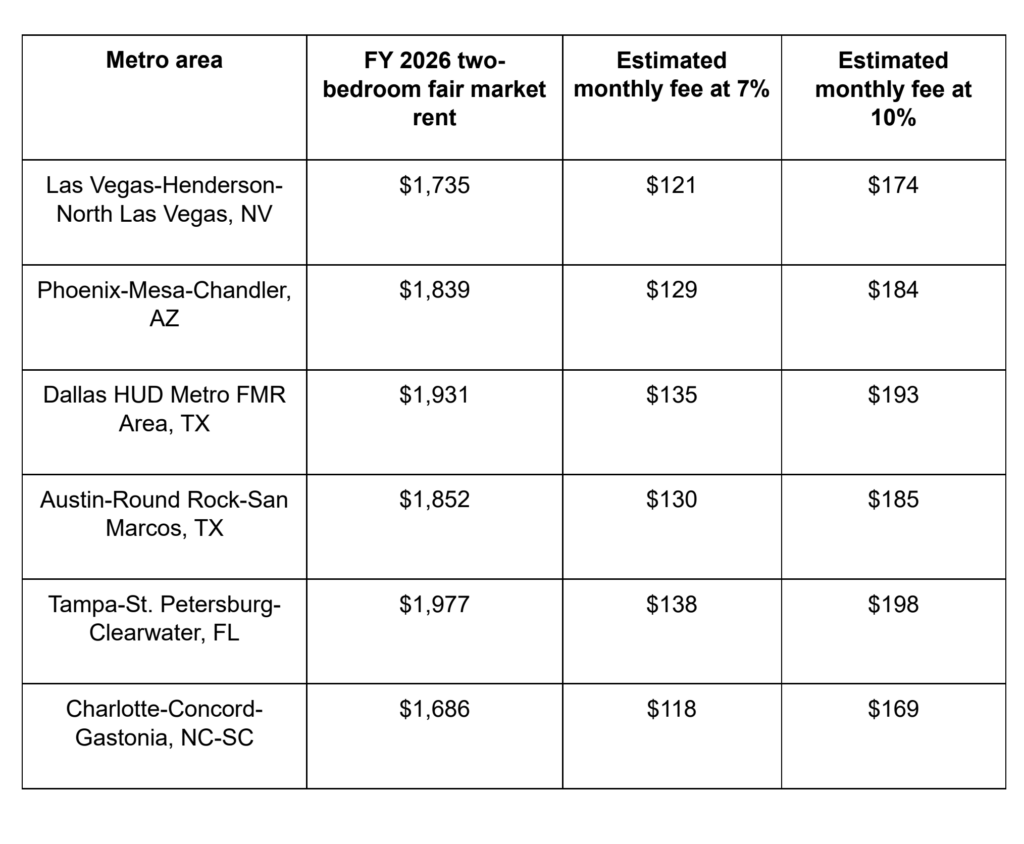
These figures are estimates, not quoted market rates. They show how even the same percentage-based fee can differ across fast-growing rental markets because the underlying rent base varies.
Why the percentage fee is only part of the cost
Those estimates do not include every possible charge. Some management agreements may also include leasing fees, renewal fees, inspection fees, maintenance coordination fees, or markups on vendor work.
For landlords comparing options, the percentage of monthly rent is only one part of the cost structure. The larger question is what duties are included, how vacancies are handled, how maintenance is documented, and how quickly rent is collected.
What property managers do for rental owners
The value proposition is tied to the number of tasks property managers take off an owner’s plate. The Bureau of Labor Statistics says property, real estate, and community association managers oversee many aspects of residential and commercial properties, including maintenance, operations, rent collection, inspections, repairs, contractor coordination, complaints, records, budgets, and compliance with antidiscrimination laws. The occupation’s median annual wage was $66,700 in May 2024, and the BLS projected employment to grow 4% from 2024 to 2034, with about 39,000 openings per year.
For an out-of-state landlord or a small investor with one or two rentals, labor can become more valuable in high-migration markets, where tenant turnover, pricing decisions, maintenance demand, and leasing speed can change quickly.
Managers may advertise vacant units, suggest rent levels, track occupancy rates and lease expirations, prepare financial reports, and make sure rent, taxes, insurance, and maintenance bills are paid on time.
How tax treatment factors into the decision
Tax treatment is another factor. The IRS notes that owners who receive rental income may deduct ordinary and necessary expenses for managing, conserving, and maintaining a rental property, including operating expenses, repairs, maintenance, advertising, utilities, insurance, taxes, and related costs.
That does not mean a management fee pays for itself, and landlords still need to evaluate cash flow after mortgage payments, taxes, insurance, repairs, vacancies, and reserves. But it does mean management costs are treated as part of the operating picture rather than as a personal convenience expense.
The trade-off for landlords in growing cities
In fast-growing rental markets, the trade-off is often between paying a visible monthly fee and absorbing less visible costs: vacancy days, missed rent increases, slow repairs, poor tenant screening, late notices, incomplete records, or noncompliance with local and federal housing rules.
A $150 monthly management fee on a two-bedroom rental may look small compared with a month of lost rent, but it may look large to an owner already facing higher insurance, taxes, and repair costs.
For landlords, the clearest comparison is not simply “self-manage or hire a manager.” It is whether the owner has the time, local knowledge, vendor network, documentation habits, and legal awareness to operate the rental consistently in a market where new residents are changing demand.
In high-migration cities, professional management is most likely to be worth the cost when it reduces vacancy time, improves rent collection, prevents maintenance from being deferred, and provides owners with cleaner records for financial and tax decisions.